

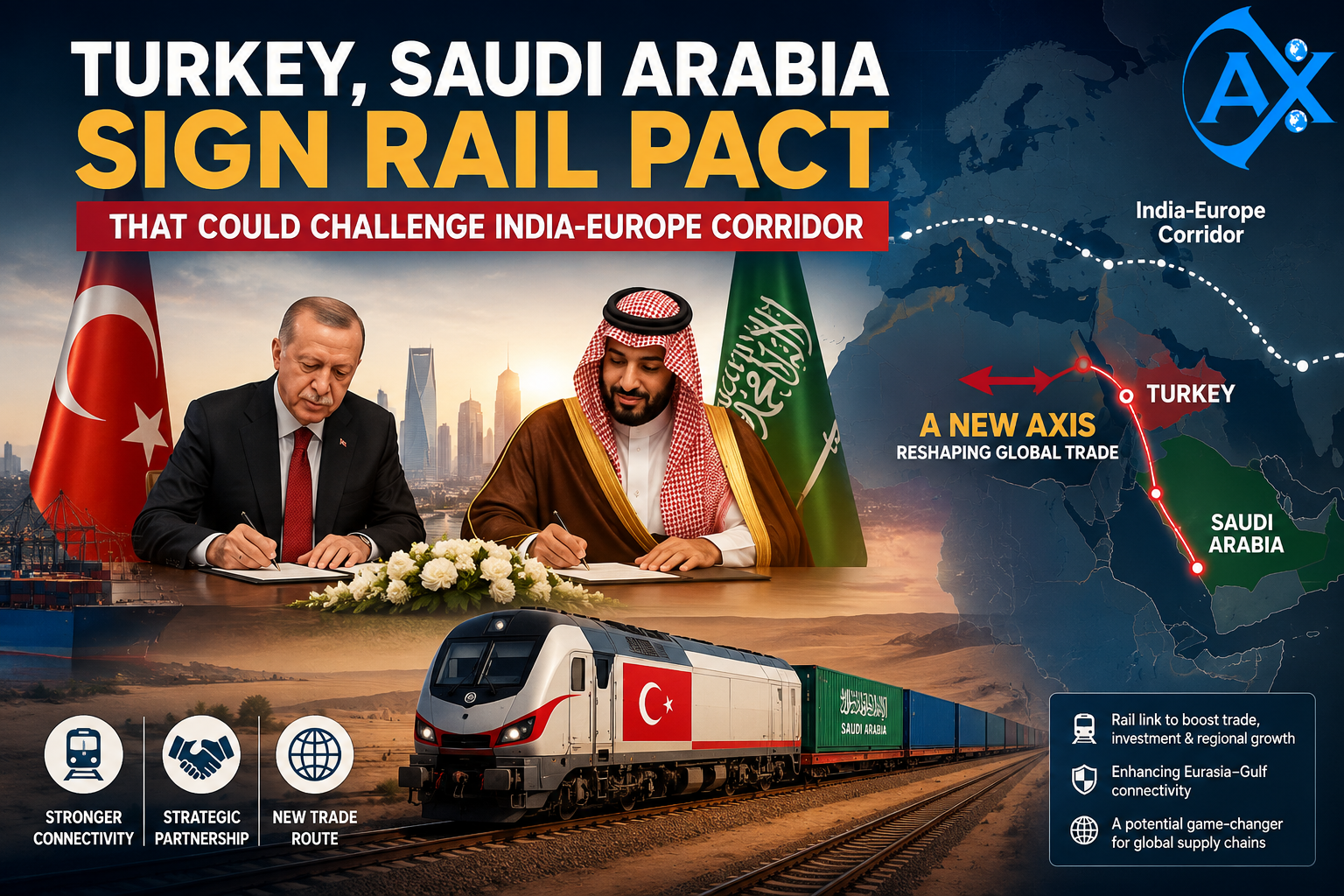
Turkey and Saudi Arabia have taken a significant step toward reshaping trade routes across the Middle East, signing new railway and logistics agreements that could eventually create a land corridor linking the Gulf to Europe while bypassing Israel—a development that may carry important implications for India’s long-term connectivity ambitions.
The agreements, signed in Riyadh by Turkish and Saudi transport officials, focus on railway cooperation, logistics infrastructure, technology exchange, and transport integration. The initiative is being viewed as part of a broader effort to revive and modernize historic regional transport networks stretching through Jordan and Syria before connecting with Turkey and European markets.
- Advertisement -
At the heart of the discussion is a proposed rail connection running from Saudi Arabia through Jordan and Syria into Turkey. Officials involved in the project say feasibility studies are expected to be completed by the end of the year, while Turkish authorities have indicated that missing rail sections in Syria and Jordan remain the primary infrastructure challenge.
The emerging route has attracted international attention because it offers an alternative to the India-Middle East-Europe Economic Corridor (IMEC), the ambitious trade initiative unveiled during the G20 summit in New Delhi in 2023. IMEC was designed to connect India with Europe through the United Arab Emirates, Saudi Arabia, Jordan and Israel, combining maritime and rail networks to reduce transit times and strengthen economic ties between Asia and Europe.
Turkey has long criticized plans that exclude it from major East-West trade corridors. Following the announcement of IMEC, Turkish President Recep Tayyip Erdoğan argued that no major trade route between Asia and Europe could succeed without passing through Turkey, prompting Ankara to pursue alternative connectivity projects of its own.
Recent regional instability has further intensified debate over future trade routes. Analysts note that conflicts affecting traditional shipping lanes and strategic chokepoints have renewed interest in overland transport corridors that can move goods between Asia, the Gulf and Europe with reduced exposure to maritime disruptions.
For India, the development presents both challenges and opportunities. New Delhi remains a key stakeholder in IMEC, which was conceived as a strategic economic corridor linking Indian ports with European markets. However, if a Turkey-Saudi rail network gains momentum and attracts wider regional support, it could introduce a competing route for trade flows between Asia and Europe.
At the same time, experts argue that the rise of alternative corridors does not necessarily undermine India’s interests. Multiple transport networks could increase regional resilience, diversify supply chains and reduce dependence on any single route. As geopolitical tensions continue to reshape global commerce, countries across the region appear increasingly focused on creating overlapping connections rather than relying on one exclusive trade corridor.
Whether the proposed railway ultimately becomes a transformative commercial artery will depend on infrastructure investment, political coordination and long-term regional stability. For now, the agreements between Turkey and Saudi Arabia signal a renewed push to redraw the logistics map of the Middle East, potentially influencing trade patterns from the Gulf to Europe—and placing India’s connectivity strategy at the center of a rapidly evolving geopolitical landscape.
