

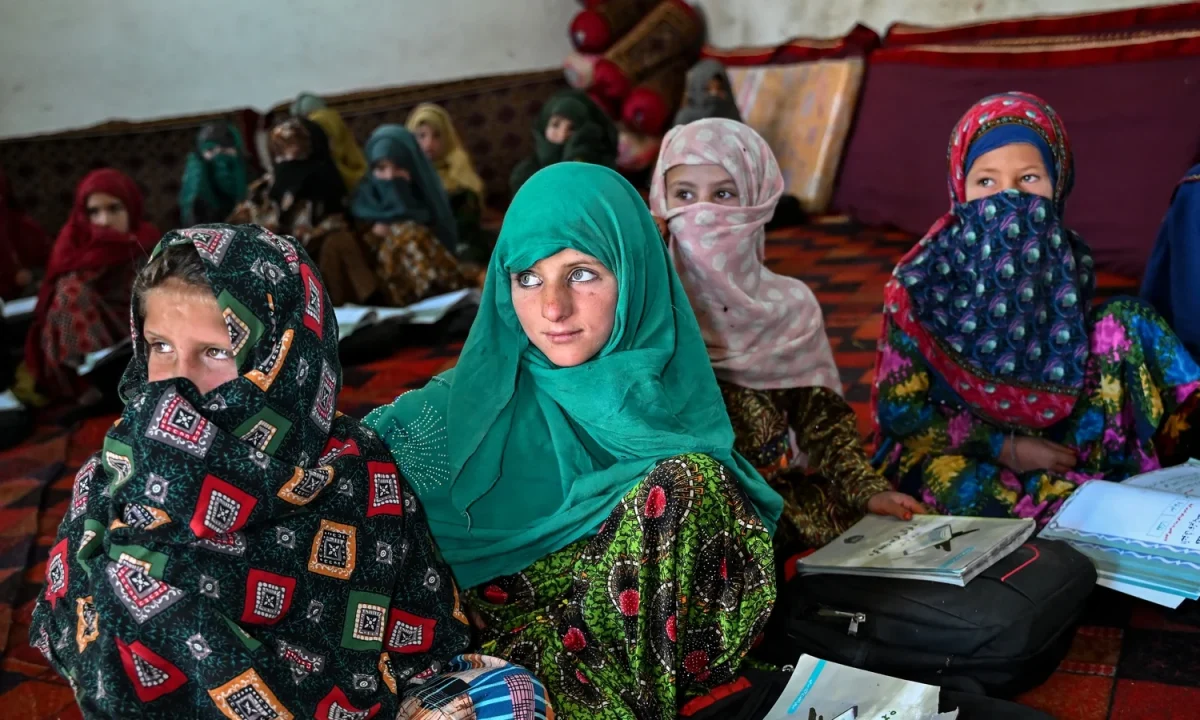
Afghanistan may have slipped from the world’s front pages, but for millions of people there, the emergency never eased.
“The perception is that Afghanistan is not in a crisis because it is out of news,” Katharina Ritz, the outgoing Head of the ICRC Delegation in Kabul, told RTÉ News.
- Advertisement -
Yet in a country of 45 million, the turmoil remains acute: international aid is shrinking, refugees are crossing back from Iran, and the Taliban are steadily tightening their grip while women’s rights continue to be stripped away.
That reality collided this week with politics in Brussels, where an EU invitation to Taliban officials for talks on deporting failed Afghan asylum seekers triggered fierce backlash.
Inside Afghanistan, the pressure was visible on the streets. Police fired on demonstrators in a rare protest over the detention of women accused of breaking the country’s harsh dress code.
At least one person was killed.
Local police described the protesters as “rioters” and said the authorities had taken “a serious, Sharia, and principled approach to any action that disrupts public security”.
Earlier, a spokesperson for the Taliban – referred to as the “de facto authorities” – said in a statement that reports of the arrests were “rumours”, adding the “hijab is a divine command, a law that we are obliged to implement”.
Taliban security personnel keeps watch amid Eid al-Fitr prayers in Kandahar
The UN and humanitarian organisations say Afghanistan’s prolonged crisis, combined with the Taliban’s ever tighter restrictions, is inflicting deep and lasting harm on the country’s social fabric.
While much of the developed world is grappling with ageing populations, Afghanistan stands in sharp contrast: it is strikingly young, with more than half of its people under 25.
Georgette Gagnon, the UN’s acting head of mission in Afghanistan, said there was “a whole generation coming of age at a time of constrained opportunity – particularly for girls, but also increasingly for boys”.
“Many are looking elsewhere for a future,” she said.
That search for safety or opportunity comes just as millions of Afghans are being pushed back from neighbouring states, many returning from Iran because of the war there and from Pakistan amid rising tensions.
Iran accelerated deportations of Afghan migrants after US and Israeli bombing last June, as the Iranian regime accused some of them of “spying” for Israel.
“It was very sad to see girls coming over,” Peter Power head of UNICEF Ireland told RTÉ News, recalling a recent trip to Herat Province on the Iranian border.
“They were arriving over in their jeans and their long hair and from their schools… into a very, very different environment,” he said.
In 2024, Meryl Streep spoke about the rights of women in Afghanistan at the UN General Assembly
Pakistan and Afghanistan, meanwhile, remain locked in a conflict that has already killed hundreds of people this year.
Pakistan says the Afghan Taliban is backing terrorism, an allegation the group rejects.
For Afghan women, conditions have continued to worsen, even 18 months after actor Meryl Streep used the UN General Assembly in New York to spotlight their plight.
A “squirrel”, she told delegates, had more rights than an Afghan girl.
“What we are witnessing are severe and growing restrictions – the imposition of systemic and institutionalised harm with long-term generational consequences for Afghan society as a whole,” according to Ms Gagnon.
To outside observers, the scale of the crackdown on women and girls can be difficult to comprehend.
Girls are barred from school after the age of 12, leaving an estimated 3.8 million girls between seven and 18 out of education, including more than 2.6 million adolescent girls.
“Each year, approximately 250,000 more girls are permanently excluded from secondary education pathways, creating a lost generation of talent and potential,” Ms Gagnon told the UN Security Council.
Last month, a decree introduced the “silence rule”, treating a girl’s silence after puberty as consent to marriage.
Amnesty International said the measure deepened an already bleak picture for the rights of women and girls in Afghanistan.
“It effectively strips them of all autonomy by eliminating any notion of consent, granting male relatives control over marital arrangements and providing minimal avenues to challenge forced unions,” said Isabelle Lassee, Amnesty International’s Deputy Regional Director for South Asia.
“Its provisions collectively institutionalise and normalise child marriage,” she said.
Women cannot go to parks, gardens, gyms, public baths, and restaurants
Women are shut out of most public sector employment and are being squeezed out of healthcare roles as well, even as maternal mortality climbs.
For every 100,000 births, 521 mothers die, according to UN figures.
That amounts to one woman dying in childbirth every hour.
Women cannot go to parks, gardens, gyms, public baths, and restaurants.
They cannot leave home unless they are fully covered.
Even their voices are not permitted to be heard in public.
These rules are enforced by the Ministry for the Propagation of Virtue and the Prevention of Vice, better known as the “morality police”.
The ministry was set up soon after the Taliban retook the country following the 2021 US withdrawal and has, according to the UN, overseen the systematic removal of women from public life.
For the international community, the Taliban’s tightening hold has created a stark dilemma, UN officials say.
Kwabena Asante-Ntiamoah, representative of the UN’s population fund in Afghanistan (UNFPA), which leads on reproductive health, said the choice has become one of engaging with the de facto authorities or abandoning the population.
UN agencies, he said, have chosen engagement.
“Let me give you a practical example,” he told reporters on a visit to UN headquarters this week.
“We currently have a ban on female medical institutes,” he said.
“I need to engage, let’s say, with the Minister of Public Health to get his understanding and to see what are the dynamics that are ongoing,” he added.
Whether UN member states should formally recognise the Taliban is a matter for the Security Council and General Assembly, he said.
Afghanistan is still represented in New York by an ambassador from the former republic, which no longer exists.
Recognition, Mr Asante-Ntiamoah said, “is a very political sensitive question”.
He said: “However, for the UN agencies, funds, and programmes, we cannot abandon the Afghans – that is the point.
“We cannot just abandon Afghans because of the Taliban.”
Data from Georgetown Institute for Women, Peace and Security
Still, the EU’s engagement with the Taliban drew sharp criticism this week.
Before a planned meeting in Brussels with Taliban officials on the return of failed Afghan migrants, opponents denounced the move as “a nadir”.
“These talks are not about the sweeping restrictions on women’s rights,” said Shada Islam of New Horizons Project, a Brussel’s based consultancy, writing in the Guardian.
“They are about forcibly deporting asylum seekers whose claims to protection in Europe have been rejected – deportation to a country where returnees face arbitrary arrest detention and torture, and which is in the midst of a food crisis,” she wrote.
The EU does not recognise the Taliban regime.
Its humanitarian aid to Afghanistan – some €160 million – is intended to bypass the de facto authorities and go directly to aid and emergency relief organisations.
The People’s Tribunal for Women of Afghanistan, a civil-society group created to investigate human rights abuses, urged the EU to cancel the invitation.
In a statement, the group called it “a dangerous step forward towards the normalisation of a regime responsible for gender persecution”.
“This invitation contradicts the EU’s own stated human rights principles and contributes to the protection of authoritarian regimes when they align with EU interests,” the statement added.
EU officials defended the discussions, saying they were “technical” in nature and focused on curbing irregular migration and accelerating deportations.
The controversy comes as a sweeping overhaul of the EU’s migration rules began implementation on Friday.
EU countries received around a million asylum applications from Afghans between 2013 and 2024, according to the EU Agency for Asylum.
“It’s no option not to talk to these people in order to improve the situation,” said Magnus Brunner, the EU’s commissioner for migration.
But activists warn that even narrowly framed contact risks giving the Taliban greater legitimacy on the world stage.
“Taliban are good at gaining from these negotiations without making any concessions,” Fawzia Koofi, Vice President of the Afghan National Assembly before its collapse as the Taliban seized power, told France 24.
“Because they don’t have anything to lose,” he added.
Ms Koofi, who survived two assassination attempts, said: “It’s us, the people of Afghanistan, the women of Afghanistan, that are losing.
“We are losing every day.”
